

Why Equity-Based Sliding Scales Matter in Mental Health Practice
Sliding scale fees are one of the most talked-about and least examined practices in mental health. Clinicians either offer them as a vague gesture toward access or avoid them entirely because the financial math feels unsustainable. Very few are doing the thing that actually makes a sliding scale an equity practice rather than a charity gesture.
This post is for WA-licensed clinicians who want to think more clearly about what an equity-based sliding scale actually is, why it matters clinically and ethically, and what it requires to implement one without burning out your practice in the process.
What a Sliding Scale Is Not
A sliding scale is not a discount for clients you feel sorry for. It is not a way to fill slots that would otherwise sit empty. It is not charity, and framing it as charity (even internally) creates a power dynamic that undermines the therapeutic relationship before the first session begins.
When a client perceives that they are receiving reduced-fee services as an act of clinician generosity, the relationship is already asymmetrical in a way that makes authentic therapeutic work harder. The client may feel indebted, may minimize their needs, or may struggle to advocate for themselves in the relationship. None of that serves clinical outcomes.
An equity-based sliding scale is something different: it is a structured fee system built on the recognition that access to mental health care is shaped by systemic factors (e.g., race, class, disability, immigration status, historical exclusion from wealth-building) that are not the client's fault and not within their individual control to solve. The sliding scale is the practice's acknowledgment of that reality, built into its business model rather than offered case-by-case as an exception.
The Clinical Case for Equity-Based Access
Financial stress is one of the most consistent predictors of poor mental health outcomes. Clients who are stretching to afford therapy are not able to fully engage in the therapeutic process; part of their cognitive and emotional bandwidth is consumed by the anxiety of whether they can sustain the cost.
When a client is paying a fee that is genuinely proportionate to their financial reality, that barrier is reduced. The therapeutic relationship has more room. The work can go deeper because the client is not quietly calculating whether they can afford to come back next week.
This is not a soft clinical argument; it is a practical one. A client who can sustain treatment at a fee that does not cause financial strain will make more progress than a client who drops out after six sessions because the cost became unsustainable.
What Makes a Sliding Scale Equity-Based Rather Than Ad Hoc
Most sliding scales are informal. A client mentions financial hardship, the clinician offers a reduced rate, and both parties feel slightly awkward about it. This approach places the burden on the client to disclose and advocate. This disproportionately disadvantages clients from communities where asking for help carries stigma, where navigating institutional systems has historically resulted in harm, or where the power differential between client and clinician is already pronounced.
An equity-based sliding scale removes that burden. It is published, transparent, and structured. Clients do not have to prove their need or ask for a favor. The fee structure exists as a matter of practice policy, and clients select the tier that reflects their actual financial situation without negotiation or disclosure.
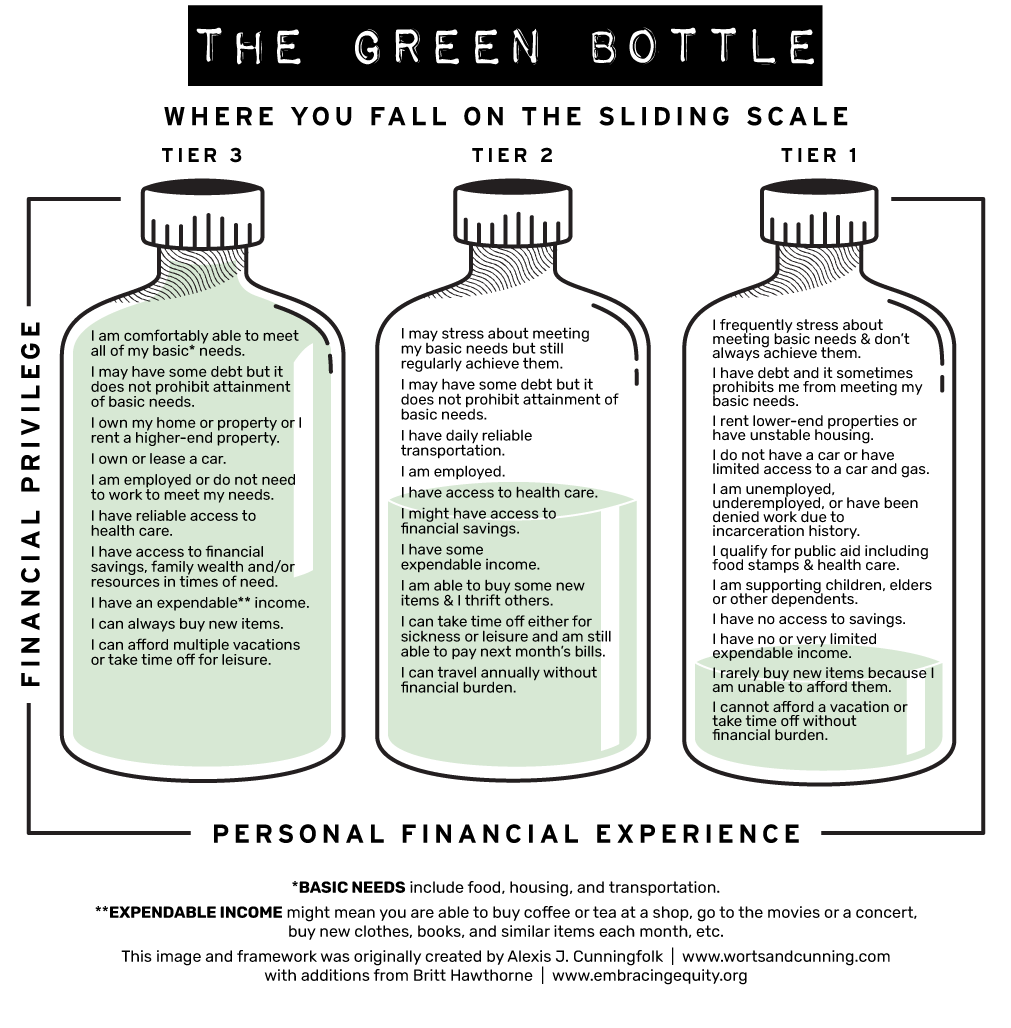
Several frameworks exist for structuring this. The Green Bottle sliding scale model, developed by Alexis J. Cunningfolk, offers a detailed approach to helping clients assess their own financial position accurately. They assess not just income, but wealth, access to family financial support, job security, housing stability, and other factors that determine real financial privilege. The result is a scale that asks clients with more access to resources to pay more, which funds the availability of lower fees for clients with less.
The Business Model Question
The most common objection to equity-based sliding scales is financial sustainability. If you reduce fees, how do you keep the lights on?
This is a legitimate question and deserves a real answer rather than a values-based dismissal.
An equity-based sliding scale requires that some clients pay at or above your standard rate in order to fund the availability of reduced rates for others. This means the scale only works if it is structured and full, not if every client is at the bottom and you are absorbing the difference personally.
For solo practitioners, this often means being intentional about caseload composition. A practice that reserves a specific number of sliding scale slots (and fills the rest of the caseload at full or higher fees) can sustain access without the clinician absorbing unsustainable financial loss.
For group practices and cooperatives like Divergent Minds Collective, there is an additional mechanism: the collective can build access commitments into its shared business model rather than leaving each clinician to manage the math individually. Shared infrastructure, collective marketing, and pooled resources make equity pricing more sustainable at the organizational level than it is for an individual practitioner working alone.
The Ethics Dimension for WA Clinicians
WA-licensed clinicians operating under AAMFT, NASW, and ACA ethics codes have explicit obligations around nondiscrimination and access to services. Providing care only to clients who can afford full-fee rates is not ethically neutral, neither is providing to only clients with private insurances.
This does not mean every clinician must offer sliding scale services. It means that the decision to not offer them should be made consciously and with awareness of who gets excluded as a result, not by default, not because the billing software makes flat rates easier.
Equity-based sliding scales are one concrete mechanism for putting anti-oppressive values into practice structure rather than leaving them at the level of values statements.
---
*Connect Counseling and Consulting offers equity-based sliding scale fees for eligible clients. To learn more about our approach to accessible mental health care, visit connect-counseling.co.*
*For clinicians building practices that reflect anti-oppressive values, the asynchronous version of Responsive Boundaries: Cultivating Clinical Integrity is coming soon! This course addresses the intersection of ethics, power, and clinical decision-making under WA standards.*